
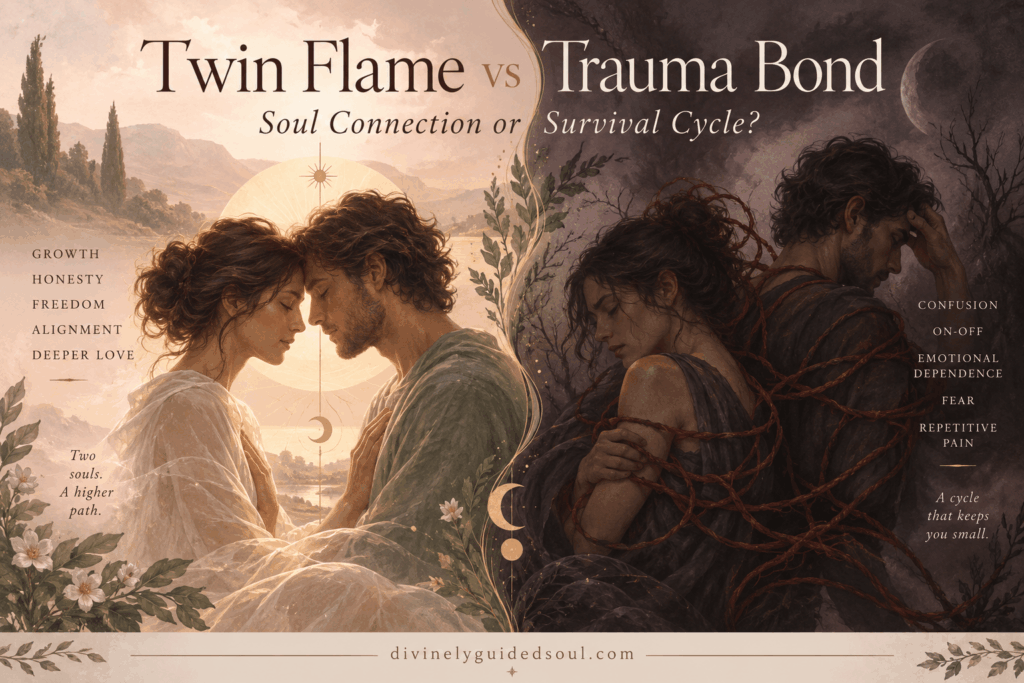
The twin flame vs. trauma bond question is one of the most honest questions a person on a spiritual path can ask and one of the most difficult to sit with. Both connections arrive with the same intensity, surface your deepest wounds, and can feel like destiny. And yet they are pointing you in entirely different directions.
I have sat with this question myself, and I have sat with it alongside many of the people who come to this space. The confusion is real. That doesn’t mean you are naive or unhealed. It means you are genuinely trying to understand what is happening inside you, and that willingness is already the beginning of clarity.
You may also find yourself asking the question the other way around: “Is this a trauma bond or a twin flame connection?” The label matters less than understanding what the relationship is doing to your emotional health, sense of self, and ability to make clear choices.
This post will walk you through what each connection is, how they differ in energy and outcome, why they can feel so similar, and how to begin finding your own answers.
Professional support note. This article is for reflection, not diagnosis or treatment. If a relationship feels unsafe, or if this work brings up more than you can hold alone, please reach out to a qualified therapist or counselor.
What a Twin Flame Connection Is
A twin flame is often described as a mirror soul: a person who reflects your deepest truths, your unresolved wounds, and your highest potential back to you simultaneously. Typically, the meeting carries an unmistakable quality of recognition. Not familiarity in the ordinary sense, but something deeper. A sense that the soul already knew.
The purpose of the twin flame connection is not romantic fulfillment, even when it takes a romantic form. Rather, it is awakening. The connection consistently activates what is unhealed and calls both people toward their own inner work. As a result, it can be simultaneously the most profound and the most destabilizing relationship of a person’s life.
Purpose: Growth, awakening, and return to your own wholeness.
Core energy: Within the twin flame framework, the connection is understood as expansive, with difficult phases often interpreted as invitations toward greater self-awareness and growth.
Outcome: A deepening relationship with yourself, whether or not physical union with the other person is ever fully realized.
The stages, dynamics, and mirroring patterns of this bond are explored in Twin Flame Dynamics: Sacred Dance of Healing, Mirroring, and Union.
What a Trauma Bond Is
A trauma bond forms when emotional attachment develops through cycles of inconsistent love, fear, or pain. Rather than being rooted in soul recognition, it draws on the nervous system’s survival mechanisms. When comfort and distress are delivered by the same person, the attachment that forms can become extraordinarily difficult to leave, not because the connection is sacred, but because the body has learned to associate that person with both the wound and its temporary relief.
Trauma bonds are not a sign of weakness. In fact, they are a predictable neurological and psychological response to intermittent reinforcement. They are often seeded in early life, in relationships with caregivers who were sometimes warm and sometimes frightening, and subsequently reach forward into adult partnerships in ways that can feel beyond rational understanding.
Purpose: Subconscious repetition of unresolved attachment wounds.
Core energy: Contracting. The connection depletes rather than expands.
Outcome: Exhaustion, loss of self, emotional confusion, and a recurring cycle that feels impossible to break.
For a grounded exploration of what trauma bonds are and how they form, Understanding Trauma Bonds is a thorough companion piece to this post.
Twin Flame vs. Trauma Bond: The Key Differences
The table below maps the core distinctions. These are not always visible from inside the connection, which is why the feeling of confusion is so common. But held at a distance, the differences in energy, direction, and outcome become clearer.
| Twin Flame Connection | Trauma Bond | |
| Energy | Expansive. Activates both shadow and light, pointing always toward growth. | Contracting. Fuelled by fear, dependency, and survival instincts. |
| Core lesson | Self-love, surrender, and spiritual evolution. | Repetition of old wounds. Survival mode rather than growth mode. |
| Relationship pattern | May involve separation and triggers, but within the twin flame framework, the connection is understood as one that ultimately encourages growth, self-awareness, and deeper personal reflection. | Push-pull cycles of idealization, devaluation, and reconciliation. |
| How it feels | Intense love, a sense of recognition, and inner transformation, even in the pain. | Anxiety, fear of abandonment, and a slow erosion of self-worth. |
| What it does to your sense of self | Returns you to yourself. You become more aligned with your authentic nature. | Pulls you away from yourself. Identity and voice gradually diminish. |
| Outcome | Freedom, awakening, and wholeness, whether or not physical union occurs. | Stagnation, emotional exhaustion, and confusion about your own reality. |
| Boundaries | Growth should allow space for boundaries and individuality. | Boundaries may repeatedly be ignored, punished, or difficult to maintain. |
| Accountability | Conflict can lead to reflection and meaningful change. | Harm may repeat through apology, reconciliation, and another cycle |
The most important distinction in this table is the direction the connection takes you over time. Both connections surface pain. Both involve intensity. The distinction that matters is not how they feel at the peak, but where they are consistently pointing you over time.
Why the Two Connections Feel So Similar
The overlap between twin flame and trauma bond experiences is not incidental. It is structural. Both experiences can involve strong nervous-system activation, especially when attachment wounds and fear of loss are involved. Both, too, carry a magnetic pull that can feel like fate.
There are specific elements that both share. An intensity at the first meeting that bypasses ordinary social caution. A sense of having known this person before. Emotional triggers that surface old wounds. Cycles of coming together and separating. Additionally, there is a pull that persists even when the rational mind is telling you to walk away.
The difference, however, does not live in the intensity of the feeling. It lives in the quality of what the connection does to you over time. A twin flame bond, even at its most difficult, tends to produce self-awareness, growth, and a deepening sense of your own truth. A trauma bond, by contrast, tends to produce the opposite: a narrowing of self, a loss of voice, and an increasing dependence on the other person’s behavior to regulate your own emotional state.
How to Tell If It Is a Twin Flame or Trauma Bond
Clarity rarely arrives all at once. It comes through accumulation. Small moments of honesty with yourself, patterns noticed across time, and the slow emergence of a truth you have been circling without quite landing on.
A question worth holding
After being with this person, or even after thinking about them, do you feel more yourself or less yourself? Answered honestly over time, that single question carries more information than almost any framework can provide.
When I first sat with that question about a connection of my own, my instinct was to argue with the answer. That instinct is worth noticing too. The wish to reinterpret what you already know is usually the loudest signal in the room.
Healing From a Trauma Bond
Recognizing that your connection carries more of the trauma bond pattern than the twin flame is not a failure. It is the beginning of something. The bond formed for a reason, and that reason was your nervous system doing exactly what it learned to do. Understanding this allows you to approach healing with compassion instead of shame.
Recovery is rarely a straight line, and it almost always needs support beyond what you can give yourself. A trauma-informed therapist or counselor offers what reading and reflection cannot. Their steady presence gives the nervous system a safe place to relearn.
A practice for the weeks ahead
Learn the mechanics of the cycle so that its next turn loses the power to surprise you.
Create distance and structure around contact, rather than relying on willpower in the moment.
Rebuild your own inner voice through writing, slowly and without judging what appears.
Return to the parts of your life that existed before the relationship absorbed them.
Practices for protecting and rebuilding your energy during this process are covered in Energy Protection: How to Set Boundaries and Practice Self-Care.
Healing Within a Twin Flame Journey
Even a genuine twin flame connection is not without pain. The mirroring function of the bond means it will surface exactly what you most need to face. Separation phases, triggering dynamics, and the challenge of being with someone who reflects your shadow as clearly as your light are all part of the path.
The healing work this connection calls for tends to move through several layers. Shadow work, which means facing the fears, wounds, and limiting beliefs that the connection is activating, rather than projecting them outward. Inner child healing, which means attending to the early attachment wounds that are surfacing in the connection. And surrender, which means releasing the grip of trying to control the connection’s form or timing and trusting the deeper intelligence at work.
Healing the inner child is one of the most important layers of this journey. Healing the Inner Child Through Shadow Work offers a grounded place to begin.
The balance between inner masculine and feminine energies also plays a significant role in navigating the twin flame dynamic with steadiness. Balancing Inner Masculine and Feminine Energies explores this in depth.
Journal Prompts for Honest Inquiry
These prompts are not a diagnostic checklist. They are invitations to self-inquiry, and they tend to surface more on paper than in thought alone. Take your time. The goal is not to label the connection quickly but to understand what it is asking you to notice in yourself.
Sit with one prompt at a time.
When I am with this person, or just afterwards, do I feel expanded or contracted? More alive or more depleted?
Across this connection, am I becoming more of myself, or am I losing access to my own voice, needs, and knowing?
Is the growth I am experiencing happening because of this relationship or despite it?
When I imagine a future without this person, what is the dominant feeling? Relief, grief, fear of abandonment, or something else?
Does this connection point me toward my own inner work, or does it keep me focused on the other person as the source of resolution?
No right answers exist here. What matters is the honesty you bring. If writing feels difficult to start, Shadow Work for Beginners offers a gentle entry point into this kind of inquiry.
Twin Flames and Trauma Bonds on Screen
Stories have always been one of the ways people make sense of their own experience. Watching a dynamic play out on screen can create the distance that lets you recognize something you could not see while you were inside it.
Soul connection on screen runs through The Matrix, where Trinity recognizes Neo’s potential before he can see it himself, which is the mirror soul function made visible. Before Sunrise and Before Sunset show a connection that transforms both people precisely because it asks for truth rather than comfort. The Fountain holds eternal love and rebirth with the spiritual depth some twin flame connections carry.
Trauma bonding appears most honestly in It Ends With Us, where charm and intensity give way to cycles of harm, denial, and return. Blue Valentine shows the erosion that unresolved attachment wounds produce over years. Gone Girl sits at the extreme end, where manipulation and mutual wounding hold the bond together in place of love.
Watch with this distinction in mind, and notice what resonates and why. Recognition on screen often arrives before recognition in your own life.
Frequently Asked Questions
When a twin flame connection turns into a trauma bond
It can happen, and honesty about that matters. If both people carry deep unhealed wounds and neither is willing to do their inner work, the dynamic can slide into patterns that function like a trauma bond. The direction is not fixed. What determines it is the degree to which both people face themselves, rather than using the connection as a substitute for that work.
Why intensity alone does not signal a twin flame
Intensity is not a marker of soul recognition. Trauma bonds are often overwhelming, because the mix of attachment and fear keeps the nervous system on high alert. A twin flame connection is marked by its consistent direction, toward self-awareness, healing, and a deeper relationship with your own soul.
What healing a trauma bond can and cannot mean
Sometimes both people commit to understanding the pattern and doing the work, often with professional support, and the relationship does change. Healing the bond does not always mean continuing it. Sometimes the healthiest outcome is a compassionate separation in which both people heal independently. The goal is not to save the relationship. It is to save yourself.
How grounded love differs from fear-based attachment
Grounded love feels steady, spacious, and expansive, even when it is difficult. Fear-based attachment feels urgent, contracted, and consuming. Notice what happens in your body when you imagine the relationship ending. Grief is a natural response to loss and indicates nothing on its own. Panic, or a sense that you cannot survive without this person while the relationship is causing harm, is worth examining carefully.
What to do while the answer is still unclear
Uncertainty is not a problem to solve today. It is information. Sit with it, write honestly, and watch the pattern across months rather than moments. If the connection consistently leaves you depleted, destabilized, or less yourself, take that seriously regardless of what you call it. You do not need a label before you begin taking care of yourself.
