
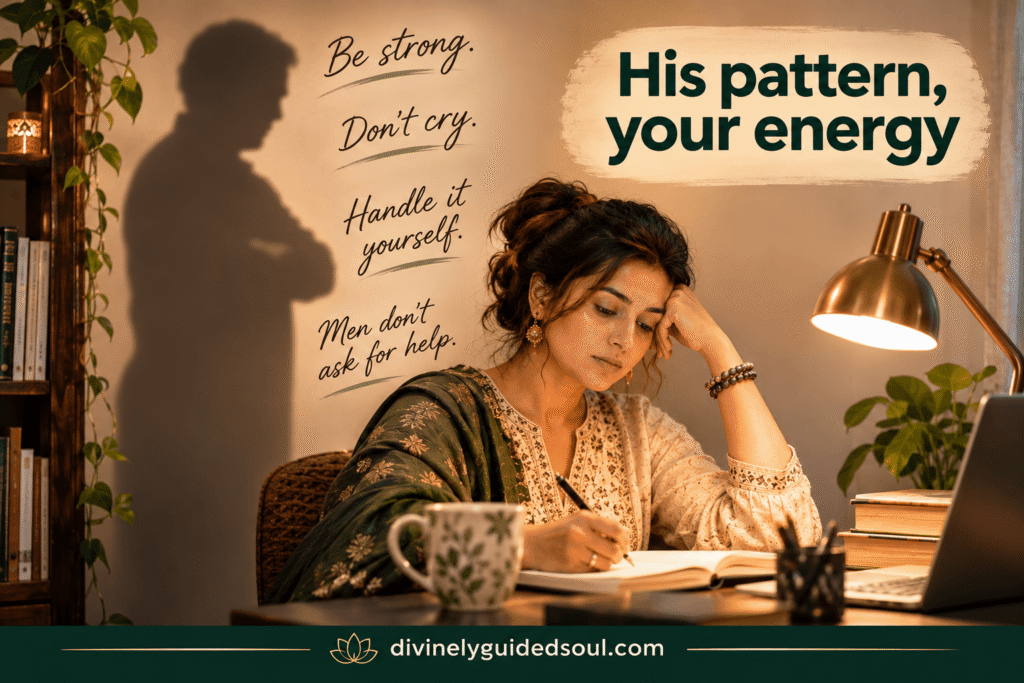
The wounded masculine often shows up as a gap between knowing and doing. You know which course you want to take, yet the form has been sitting half-filled for three months. On other days, you swing the other way and try to control every detail of a family trip until everyone is tired.
If that sounds familiar, you are not lazy, and you are not too much. In spiritual language, both patterns can point to a wounded masculine, an inner energy that never learned to feel steady. By the end of this post, you will have one small step you can try today.
Not every experience here will match yours, and that is okay. The purpose is not to blame your father but to understand how he may have shaped the way you act and decide. These ideas are tools for reflection, not a diagnosis. For the wider picture, read the main guide to the father wound.
What the wounded masculine means: masculine energy, not gender
Everyone carries both masculine and feminine energy, whatever their gender. Masculine energy is your doing energy: planning, deciding, protecting, and taking action. Feminine energy is your being energy: feeling, resting, receiving, and connecting.
Think of a festival dinner at home. Your feminine side imagines the warm evening and the people around the table. Meanwhile, your masculine side writes the shopping list and gets the food ready on time. You need both.
Wounded simply means this doing energy learned to cope in a way that no longer helps. Sometimes it shrinks and stops acting. At other times, it pushes too hard and tries to control everything.
Wounded masculine versus divine masculine
The divine masculine is healthy doing energy. You still plan, protect, and act, but you stay calm instead of scared or bossy.
For example, a family reaches a crowded railway station. The father keeps the tickets ready and makes sure the children stay close. He does not shout or panic. Everyone feels safe, and nobody feels controlled. That calm way of taking charge is the divine masculine.
| Quality | Wounded masculine | Divine masculine |
|---|---|---|
| Planning | No plan at all, or a rigid plan | A simple plan you can adjust |
| Boundaries | Saying yes to everything or controlling others | Saying no kindly and clearly |
| Action | Freezing, or forcing | Taking one steady step at a time |
| Decisions | Endless doubt, or rushed choices | Choices you can stand behind |
| Strength | Fragile, or harsh | Strong and gentle together |
Most people show a mix. You might be decisive at work and stuck at home. Look for the row that feels most true for you right now.
How the father wound shapes your masculine energy
For most children, a father is the first teacher of doing energy. Long before we can explain it, we watch how he plans, protects, decides, and handles problems. We also feel whether his presence made us feel safe. Both lessons quietly shape how our own masculine energy grows.
Think of it like learning a language at home. A child who hears calm, clear words learns to speak calmly. One who hears shouting or silence learns that instead. Nobody sits the child down to teach these lessons, yet they stay for years.
Here are some common ways a father’s pattern can shape a child’s masculine energy:
| Father’s pattern | What the child may learn | How it can show up in adult life |
|---|---|---|
| Unreliable or absent, like a father who promised bicycle lessons every Sunday and rarely came | Plans never really happen, so I can only count on myself. | Avoiding plans, or doing everything alone |
| Harsh or controlling, like a father who shouted orders | Strength means control, and mistakes are dangerous. | Controlling others, or freezing around authority |
| Overprotective, like a father who filled every form and solved every problem | I cannot handle things on my own. | Indecision and waiting to be rescued |
| Avoidant, like a father who left the room whenever there was an argument | Problems are better ignored. | Weak boundaries and avoiding hard conversations |
| Always working, like a father who came home after everyone was asleep | My worth depends on how much I do. | Overworking and guilt when resting |
| Unpredictable, like a father who was calm one day and angry the next | I must stay alert and keep everything under control | Anxiety and a strong need for control |
| Steady and present, like a father who kept his word calmly | Strength can be calm and kind | Healthy, balanced masculine energy |
Children usually respond to a father’s pattern in one of two ways. Some copy it. Others do the exact opposite. Imagine two brothers raised by the same shouting father. The older one grows up to shout at his own team. His younger brother never raises his voice, even when someone crosses a clear line. They look completely different, yet the same wound shapes both. The first has an overcharged masculine, and the second has a collapsed one.
Your body remembers these lessons too. Years later, a manager’s sharp tone may tighten your stomach before you even think about it. A partner’s sudden silence may make you rush to fix everything. These reactions are not weakness. They are old safety habits that once helped a child cope.
None of these children chose their lessons. They simply adapted to the father they had. The hopeful part is this: whatever was learned can also be relearned. Your masculine energy can still grow steady, at any age.
Signs of a wounded masculine
The wounded masculine usually leans one of two ways. Many people move between both.
When it shrinks: the collapsed masculine
When this energy shrinks, taking action feels hard. You may notice that:
- You wait for the perfect moment to ask for a raise, and two years pass.
- Small choices, like a birthday gift for a friend, take days of scrolling and second-guessing.
- You say yes to every favor, then feel drained and quietly resentful.
- You start projects with excitement but rarely finish them.
- When someone asks what you want, you answer “anything is fine.”
- You avoid difficult conversations and hope problems will fix themselves.
- You let others make big decisions about your life.
- Part of you hopes someone will step in and rescue you.
When it pushes too hard: the overcharged masculine
When this energy pushes too hard, action turns into control. You may notice that:
- You plan every hour of the holiday and feel annoyed when your family wants to wander.
- At work, you redo your team’s tasks late at night because letting go feels risky.
- Rest feels like weakness, so you keep going even when you are exhausted.
- You give advice when someone only wanted to be heard.
- Small changes to your plans make you irritated or anxious.
- You struggle to ask for help, even when you badly need it.
- You measure your worth by how much you get done.
- Arguments feel like contests you have to win.
Nobody matches every sign. These patterns look different in different people, and many have more than one root. Recognizing one or two is enough to take your experience seriously. Matching the whole list is not the point.
The wounded masculine in women: hyper-independence and excess masculine energy
Many women carry this wound as hyper-independence. If a father was unreliable, a daughter may decide early that she can only count on herself. In women, the wounded masculine can show up in ways like these:
- You carry every shopping bag up the stairs, even when your partner offers to help.
- You handle the bills, repairs, and family plans alone, then feel quietly hurt that nobody helps.
- You still cook dinner for everyone when you have a fever, because resting feels like letting people down.
- A gift, favor, or compliment makes you uneasy, so you rush to repay it.
- You find it hard to let a partner plan the date, choose the route, or lead a decision.
- You hide sadness or fear, because showing softness feels unsafe.
- Friends call you “the strong one,” yet few people ask how you are really doing.
- You feel drawn to people who need fixing, because being needed feels safer than needing someone.
From the outside, you look strong, and you are. Inside, though, you may feel tired and alone. The goal is not to become less capable but to let strength and rest live side by side. For more on this, you need to manage everything; see the Controller archetype
How to heal the wounded masculine and balance masculine and feminine energy
You do not need a big plan to begin. Healing this energy starts with small actions repeated often, because trust is built one kept promise at a time. You do not even have to believe it will work. Just try one step and notice what happens.
Small steps work because your inner energy learns through experience, not through advice. You can read a hundred times that you are capable, yet one finished task teaches you more. Each small action proves you can plan, decide, and follow through safely.
Step 1: Notice which way you lean
Before changing anything, spend two or three days simply noticing. Do you freeze, delay, and wait for others to decide? Or do you push, control, and struggle to rest? Many people find they shrink in one area of life and push too hard in another, such as at home versus at work. Write down one moment each day when you noticed the pattern. Noticing without judging is already the first step of healing.
Step 2: Pick your starting point
If you tend to shrink, your practice is tiny action. Send that email after one read instead of five, or make the phone call you have been avoiding. Book the doctor’s appointment you keep postponing. Each small action shows you that doing something imperfectly is safer than doing nothing.
If you tend to push too hard, your practice is letting go. Let a friend choose the restaurant, or let a colleague finish a task their way. Leave one chore undone for a day and notice that nothing falls apart. Each time you loosen your grip, you learn that the world can hold some of the weight.
If you do both, choose one small action and one small letting go each week. Balance grows from both sides.
Step 3: Keep one small promise to yourself every day
Choose something tiny, such as a ten-minute walk after lunch or reading two pages before bed. Do it at the same time every day. The size does not matter. What matters is that you keep your word to yourself again and again.
Many people with a father wound learned that promises get broken. Each kept promise slowly rewrites that lesson. Your inner child begins to learn that someone finally shows up, and that someone is you.
Step 4: Practice gentle boundaries
Healthy masculine energy protects without force. Start with one situation where you usually give in. Prepare a short, kind sentence ahead of time, such as “I cannot do that this week,” or “Let me think about it and reply tomorrow.” Say it calmly, without a long explanation. A clear boundary does not need anger to be strong.
Step 5: Balance doing with being
Masculine energy heals faster when your feminine side gets space too. Doing energy needs rest, play, and receiving to stay steady. Try twenty minutes a day with nothing to fix, such as sitting with tea by a window, listening to music, or walking without a goal. When someone offers help, practice saying “thank you” instead of “I can manage.” Rest is not the opposite of strength, but what keeps strength from turning into exhaustion.
What if it feels silly?
It might, especially at first. Keeping a five-minute promise can feel too small to matter. Small is the point, though. Big changes often fail because they ask too much too soon, while small steps are easy to repeat. Reparenting your younger self is one part of this work, not the whole of it.
What to do when you slip
You will miss a day, give in to a request, or take over a task you meant to let go. Slipping is part of the process, not proof of failure. Notice what happened without scolding yourself, and simply begin the next day again. Each restart is another chance to show yourself the kindness and reliability you once needed.
Many of the people I have supported are surprised by how much changes when they keep one small promise for a single week. Give yourself that week, using the plan below, and see what you notice.
PRACTICE:
A gentle 7-day starter plan
Day 1: Choose one tiny daily promise, such as a ten-minute walk, and decide the exact time.
Day 2: Keep the promise. Notice how it feels to follow through.
Day 3: Say one clear, kind no, such as “I will reply to this tomorrow.”
Day 4: Take one action you have been putting off, and keep it small.
Day 5: Let someone else do one thing for you, and simply say thank you.
Day 6: Rest for twenty minutes with nothing to fix or finish.
Day 7: Look back at the week and write down one thing that felt different.
Journal prompts
These are invitations, not assignments. Stop whenever you need to.
- Do I tend to shrink, or push too hard, or both?
- What did my father show me about strength and decisions?
- Where am I waiting for someone else to decide for me?
- How would it feel to let someone help me today?
- Which one small promise can I keep this week?
In the end
The wounded masculine is not a flaw in who you are. Rather, it is the part of you that learned, as a child, to hide or to grip because no one showed you a steadier way. When you froze, you were protecting yourself. Taking control was simply another way of trying to stay safe. Both made sense once.
Your father may not have been able to show you calm, steady strength. Nobody needs to give you permission, and you do not have to wait for him to change. Steady strength can begin with you, one kept promise at a time.
So start small. Choose today’s promise, keep it, and notice how it feels to show up for yourself. Seven days from now, you may not feel like a different person. Instead, you may simply trust yourself a little more, and that trust is where real strength begins.
Frequently asked questions about the wounded masculine
What are the signs of a wounded masculine?
Common signs include indecision, procrastination, weak boundaries, and waiting to be rescued, or the opposite: control, overworking, and difficulty resting. Many people show signs from both sides at different times.
What does the wounded masculine look like in a woman?
In women, it often appears as hyper-independence: doing everything alone, struggling to accept help, and feeling that rest or softness is unsafe. It can also show up as trouble setting boundaries.
Is the wounded masculine the same as toxic masculinity?
No. Toxic masculinity is a social term for harmful cultural ideas about how men should behave. The wounded masculine is a spiritual idea about an inner energy that anyone, of any gender, can carry.
What is the difference between the wounded masculine and the divine masculine?
Both describe the same energy of structure, protection, direction, and action. The wounded form is either collapsed or forceful, while the divine form is grounded, steady, and able to be firm and gentle together.
How do you heal your masculine energy?
Start small: keep daily promises to yourself, practice one clear boundary, and take imperfect action. If you tend to overcontrol, practice letting others help, and seek professional support if old patterns feel too heavy to shift alone.
